The Edge of the City by Desmond Hogan
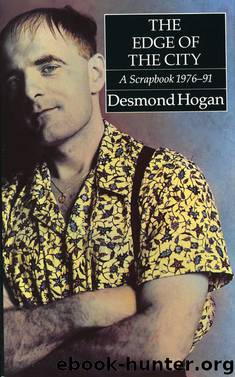
Author:Desmond Hogan [Desmond Hogan]
Language: eng
Format: epub
ISBN: 9781843512585
Publisher: The Lilliput Press
Published: 2011-09-17T04:00:00+00:00
Leningrad
‘I firmly believe in miracles. You gave me that belief, O Leningrad,’ a Leningrad poet said just after the war and on my two visits there Leningrad has struck me as having a miraculous visual quality. In January, from the Spit – the promontory – on Vasily Island, you could see figures in black picking their way over the ice on the Neva in the mysterious winter light. The soda and ice-cream parlours on Nevsky Avenue were the places to retreat for colour. Back in Leningrad on Trinity Sunday, services having been sung the night before in St Nicholas’s Cathedral and in the Alexander Nevsky Monastery, the colours of Leningrad seemed to have defined themselves out of the previous, winter void – cerulean blues, powder blues, burnt siennas, Venetian reds, almond greens, Naples yellows, buttermilk shades of white. Newlyweds toasted one another with champagne around me. Sauntering fishermen clung to peonies as well as to their rods.
Flowers are an obsessive token in Leningrad. Carrying flowers in a hotel lift you will be acknowledged by flower-bearing Russian tourists and invited to their room for a vodka or Armenian cognac. Flowers are laid by newlyweds at the tomb of Peter the Great in the Peter and Paul Fortress where Leningrad began in 1703 – chamomiles, sweet williams, carnations. They pile up beside the eternal flame in the Field of Mars, life-long benevolence invoked for newlyweds. It was the centenary of the birth of the Leningrad poet Anna Akhmatova when I was there, and on that day I watched a fleet of ambulances pull up in the cemetery in Komarova outside Leningrad, where she is buried, doctors and nurses getting out to lay flowers on her grave. In the market on Kuznecny Lane, near Dostoievsky’s home, the flower-sellers keep vigil by rows and rows of red roses.
In the ice-cream parlour on Nevsky Avenue, just opposite Marata Street, Peter the cat sat regardlessly under a table, as he had in January. Often these parlours have no name but they are nicknamed. The ice-cream parlour further down Nevsky Avenue, beside Zelabova Street, is called the Frog Café, perhaps because of the green festoons, green table coverings, green marble on the walls. Likewise with cafés. One unnamed one is called the Saigon because the eating conditions are cramped. A café bearing the name ‘The Black Coffee’ is familiarly known as the Bell because there are bells in the patterns on the walls. Café names are a kind of samizdat in Leningrad.
In January, even on trams, old people who could speak a little English, would tell you stories about the nine-hundred-day siege, many of them about the endurance of the Hermitage, the day the head of the statue of Esmeralda came off and how it was put on again after the war, how lectures on Egyptian archaeology kept going in the evenings in the Hermitage during the worst of the siege. Red carnations were strewn in the January snow in Piskariovskoye Cemetery where half a million people lie buried.
Download
This site does not store any files on its server. We only index and link to content provided by other sites. Please contact the content providers to delete copyright contents if any and email us, we'll remove relevant links or contents immediately.
Whiskies (Collins Gem) by dominic roskrow(45424)
Spell It Out by David Crystal(36149)
Cecilia; Or, Memoirs of an Heiress — Volume 1 by Fanny Burney(32636)
Cecilia; Or, Memoirs of an Heiress — Volume 2 by Fanny Burney(32010)
Cecilia; Or, Memoirs of an Heiress — Volume 3 by Fanny Burney(31996)
Beautiful Disaster by McGuire Jamie(25376)
Trainspotting by Irvine Welsh(21830)
Chic & Unique Celebration Cakes by Zoe Clark(20102)
The Secret History by Donna Tartt(19291)
How High Can a Kangaroo Hop? by Jackie French(18820)
Twilight of the Idols With the Antichrist and Ecce Homo by Friedrich Nietzsche(18689)
All the Missing Girls by Megan Miranda(16314)
Cat's cradle by Kurt Vonnegut(15441)
Ready Player One by Cline Ernest(14771)
For the Love of Europe by Rick Steves(14566)
Fifty Shades Freed by E L James(13289)
4 3 2 1: A Novel by Paul Auster(12508)
Crooked Kingdom: Book 2 (Six of Crows) by Bardugo Leigh(12366)
Grundlagen Kreatives Schreiben (German Edition) by Helfferich Pia(10487)
